


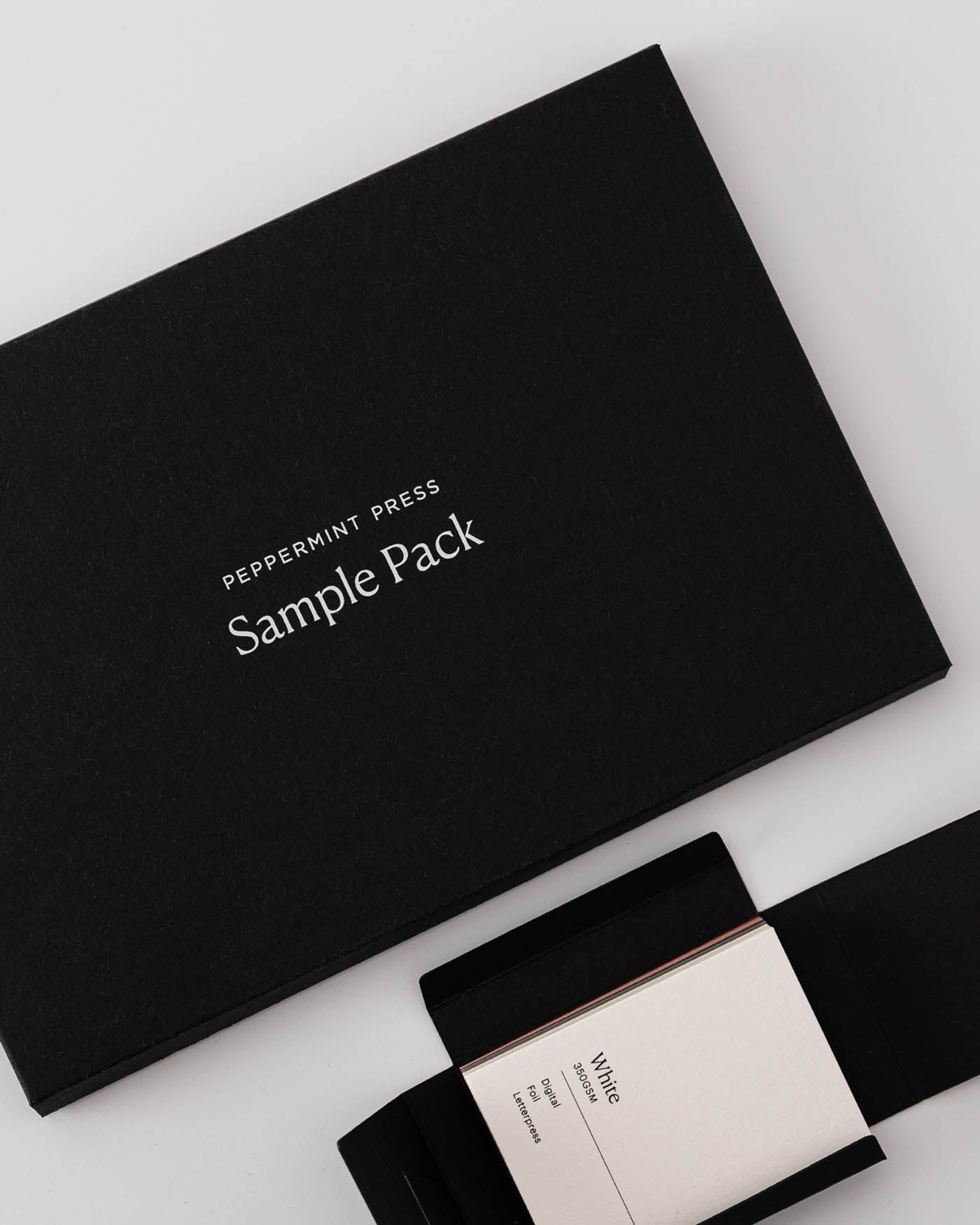

GSM. It sounds technical, looks important, and is probably not something you expected to think about when planning your wedding. But if you’ve ever wondered why one piece of stationery feels beautifully substantial and luxurious while another feels a little lighter, GSM has something to do with it. In this article, we break down what GSM means, why different papers have different GSMs, and how we at Peppermint Press choose the right paper for your invitations and stationery.
What does GSM mean in paper?
When you’re planning your wedding stationery, you probably have enough numbers to think about already. Guest numbers, table numbers, RSVP dates, budgets... the last thing you need is another mysterious abbreviation thrown into the mix. Enter GSM.
GSM simply stands for grams per square metre, and it’s a way of measuring the weight of paper. A 300 GSM sheet of paper weighs 300 grams per square metre, while a 400 GSM sheet weighs 400 grams per square metre. Easy enough!
Well, there’s a little more to it. GSM tells us about the weight of the paper, but it doesn’t tell the whole story about how it feels. Two papers can have the same GSM but feel completely different in your hands, depending on how they’re made, their fibres, texture and finish.
And this is where things get interesting for your wedding stationery (at least we think so!). The paper we choose for your wedding invitations for example, might be different from the paper we use for your menu, place card or ceremony booklet, because each piece has a different job.
So while GSM sounds like a technical paper term, you can just think of it as a part of what gives each piece that lovely feel when you pick it up and feel it between your fingers.

Tempted by the sophistication of the above menu? Take a look at our Estate collection.
So, does a higher GSM mean thicker paper?
Not necessarily! This is where paper gets a little sneaky.
GSM measures the weight of the paper, not its thickness. Generally, a higher GSM paper will feel more substantial, but two papers with the same GSM can have quite different thicknesses and textures.
Essentially it comes down to how the paper is made; the fibres used, how tightly they are pressed together, and the paper's finish can all affect how thick and tactile it feels.
Think of it a little like a sponge and a book. They could weigh the same, but they certainly wouldn't take up the same amount of space. Paper can work in a similar way.
At Peppermint Press, our 15 years of experience have given us plenty of experience with paper. And with all we know about it, this is why we don't choose paper based on GSM alone. When we're creating wedding invitations and stationery, we consider the whole picture: how the paper feels, how it looks, how it prints (very important!), and how it works with the design.
So, while GSM is a useful guide, heavier doesn't automatically mean thicker, and thicker doesn't automatically mean better. The magic is in finding the right balance!

Drawn in by the playfulness of the above invitations? Take a look at the Charlie Collection.
GSM for wedding invitations
When it comes to your precious wedding invitations, we want the paper to feel very special from the moment your guests pick it up. And that decision happens way before deciding on colour and design. At Peppermint Press, we put a lot of time into selecting our card and paper.
Your invitations need to feel substantial and luxurious, while still being practical for printing and posting. So, for our digitally printed and foil wedding invitations, we use 300 to 350 GSM card, which gives them that lovely substantial feel without making them unnecessarily heavy. It’s a sweet spot for wedding invitations, giving us a beautiful base for crisp printing and those all-important finishing touches.
And we’re not the only ones who think so! According to ThePerfectWedding.com, 300 to 350 GSM is the standard range for most wedding invitations; it is widely called the “industry gold standard”, thanks to its rigidity and ability to hold up well during mailing.
But things are a little different for our letterpress invitations, where we use 600 GSM card. Letterpress needs a bit more substance to really work its magic. The design is pressed directly into the paper, leaving a beautiful impression that you can see and feel. It gives the invitation that lovely sense of depth that makes letterpress so distinctive.
And then finally, there's the envelope. It might not be the star of the show, but it’s the first thing your guests see, so it has a job to do. Our envelopes range from 100 to 150 GSM, depending on the colour and paper (more of this to come later!), giving each one a slightly different feel.

Looking for some coasters for your big day? Take a look here.
GSM for wedding stationery
Now onto the on-the-day stationery that gets to join the party itself! Once the invitations are sent, there’s still plenty of stationery to think about for the big day.
Some of these pieces need a completely different material. Our wedding signage and bar signs, for example, are made from foam board, while our coasters use coaster board. These are designed for a very different purpose to a menu or place card and need a material that can do the job.
For the rest of our stationery however, we print onto 300 to 350 GSM card. It's our go-to. This includes our menus, place cards and favour tags, giving them enough structure to sit nicely, hold their shape and feel substantial in your guests' hands.
So when you see 300 to 350 GSM across many of our card-based stationery pieces, there’s a reason for it. It’s a tried-and-tested weight that gives the stationery the feel we’re looking for without making it heavy or stiff.

Why do different colours of paper have different GSMs?
“Hang on, if GSM is a measurement, why does my blue paper have a different GSM to my pink paper?” It’s a fair question!
What you need to know is, the colour itself doesn't changing the GSM, but different coloured papers can be made from different paper stocks. So that’s what affects the weight.
The fibres, pigments and manufacturing process can all vary between stocks, which means two colours can end up with different GSMs, thicknesses and textures.
And as you browse our website, you can see this in our own range too. Our envelopes, for example, range from 100 to 150 GSM depending on the colour and stock.
So, does higher GSM mean better quality?
You might be thinking, “Well, surely the heavier the paper, the better it is?” It doesn't actually work like that.
A higher GSM can give paper more weight and substance, but it doesn’t automatically make it better. The right choice depends on what we’re making, how it’s being printed and the feel we want the finished piece to have. When we’re choosing paper, we’re not simply reaching for the biggest number.
For example, our 300 to 350 GSM card is perfect for menus, place cards and favour tags, while our 600 GSM stock works beautifully for letterpress invitations, where the extra substance helps create that distinctive pressed finish.

Tempted by the sophistication of the above design? Take a look at our Heritage collection.
The card we use at Peppermint Press
And the good news is, you don't need to become a paper expert to have beautiful wedding stationery. That’s our job!
When you order with us, we choose the card and materials based on your design, the printing method and what each piece needs to do. You don’t need to know your 300 GSM from your 600 GSM.
We’ll make sure the paper works beautifully with your design, feels right in your hands and is suited to how your stationery will be used.
Take a look at our wedding invitations here and our 'how it works' section here.

